
Puppets & Grief

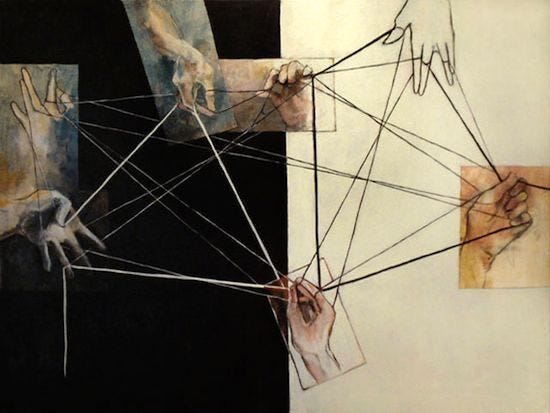
I sit in the front row, directly center, facing an oversized timber stage overlaid with an ebony lacquer that catches a glare like a still pond. The air whirs with creaks and terse whispers. Rows of ruby velvet seats cascade from the top to the bottom of the room, their doughy backs sponging the suspense of the audience. The parallel side walls rise high and alive, etched with the figures of mythic beasts, golden plaster tendrils that twist and bloom into impossible forms, and lotus columns cut by geometrical patterns. Cherubs roost upon fat cornices, and gold-plated vines climb toward the moon. The ceiling is celestial, with sapphire domes bulging, each dusted with golden constellations and framed by polished edges and waxy brass trim.
The lights dim, and I yank my gaze from the vaulted roof, back toward the stage. The cherry-red curtains part unhurriedly, dragging small palls of dust sideward. The heavy folds open, exposing the center stage, highlighted by a single piercing spotlight. The thick beam lands upon a spindly, white oak table positioned at the midpoint. It is blanketed with a baggy, claret-colored tablecloth. Three puppets stand motionless with their painted faces taut and frozen.
A throaty cello rumbles from the speakers, a hum that smoothly rises through the floorboards. More instruments join in, and the tune swells in a deep, orchestral, and ancient way. On cue, the once leaden marionettes wake. Their wooden limbs flutter, rise, then sway as their strings draw taut and ricochet like wiry nerves. It is the birth of an unrivaled performance. Timbered torsos sail across the table, impossibly light, bending, stirring, and contorting with elegance. The spotlight is creamy on their airbrushed faces, and I watch as their joints clack softly, rhythmically, in perfect obedience to the veiled palms that are twitching and tensing the twine. For a moment, I am sure the puppets are alive, muscles tensing beneath their wooden exterior. Maybe I, too, am being lifted, suspended, made to bend and fold by something vast and unseen.
I wake to the clash of wooden limbs—a fatal misstep in their routine—only to find it is my oscillating tower fan, angled toward the window, rapping against the blocky vinyl blinds. I come back to myself, skin slick against my linen sheets, disoriented and dizzied as I recognize I am no longer sprawled in those velour theater seats. I am angered, sure that I was on the verge of some profound understanding, that this strange, hallucinatory performance had promised to unveil the hidden choreography of existence: the way we bear suffering, relinquish control, and beget art. I have always known the world, in its merciless affairs, pulls at me with impalpable strings, forces that my own doing cannot command. For this momentary, intoxicating beat, I might grasp the mystery of withstanding it all, and uncover the truth about the grief that flexes and folds with me.
Now, past that anticlimactic night, I have learned much about the strings wrapped around my limbs and the performance that is survival. I understood, falsely, that my grief was one single string, taut around the chest, a lone rope that I could tighten or loosen at my will. Its placement was not consequential, merely there when I was ready to tug, easy to ignore as my limbs flailed and legs dragged on. I assumed that this suffering string would be effortless to conceal, especially when I would find myself in rooms that were gauche to a grievous spirit. I believed I could shake hands with strangers and follow the leader without ever bobbing the twine (the grief) bound to my chest. I could successfully retain my grief as imperceptible, and thus, I would be spared judgment for my bulging sorrow and fragility.
But I have learned, certainly the long-winded and complex way, that grief is in the fibers of each thread that wraps around my puppeted body. It is bound to the corners of my lips, present as I smile, weighing it down, softening its edge, depleting my cheeks of their stamina to hold this symbol of delight. It coils around my spine, twisting my posture into a bent form, a great labor to stretch against. Grief is in the dense cords ringing my hips, sorrow in each step, an ache designed to delay my progress and spoil any resemblance to onward motion. It is fraying my ideas of success and purpose, severing the beliefs I once held of who I would be and what I would work towards. It is my unwanted but permanent companion, refusing to be contained and overpowering my extravagant attempts at avoidance.
In a great, yet slightly disappointing discovery, my performance (my survival) does not involve clipping the twine, completely ridding myself of the thick grief cables. Nor do the curtains glide together in a finale of puppetry mastery, gracefully powering through the sorrowful movements until they are exhaustively under my control. And, most certainly, the performance is not pleasured by the avoidance of any motion at all. The show (my survival) is best weathered by letting grief graze each endeavor—a ravishing tangle of despair and delight —without allowing the knots to hijack the rhythm. To survive is to feel each bit of sorrow and joy, accept their interconnectedness, and move despite the grief that unfolds and erupts along the way. It is an omniscient force that, when embraced, is the mystery to a more gentle, inventive, and boundless life.
While this realization—the perpetual interconnectedness of grief with all subsequent experiences and emotions, both good and bad, after loss—was the first and potentially most liberating, numerous other enlightenments have followed.